Category
Stroke Sensors for Vibrating Screens
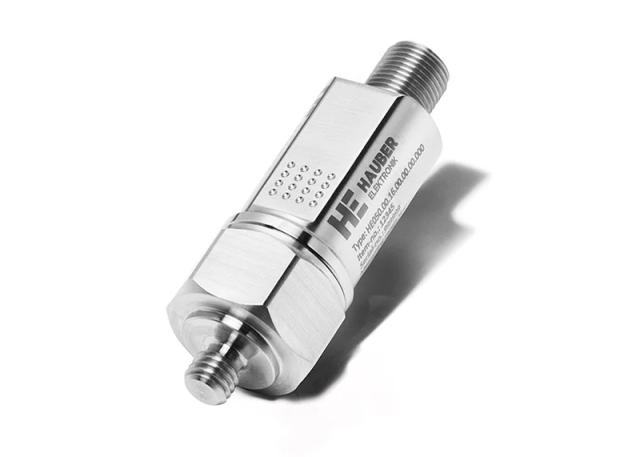
Measure stroke and displacement on machines with the Hauber-Elektronik HE050-A40.
A stroke sensor measures the peak-to-peak distance a vibrating screen or feeder moves each cycle, the stroke that determines how well material is conveyed and screened. The Hauber-Elektronik HE050-A40 measures 0 to 40 mm displacement plus acceleration, frequency and temperature, with IO-Link, 4 to 20 mA or PNP outputs. For bearing condition monitoring, see vibration sensors.
1 Product · Stroke Sensors
Selection guide
Stroke Sensors for Vibrating Screens Guide
How a stroke sensor works
As a vibrating screen or feeder runs, the deck moves back and forth in a repeating cycle. The stroke is the peak-to-peak distance it travels in that cycle: too little and material stops moving across the deck, too much or uneven and springs and structures crack. The HE050-A40 tracks that displacement continuously, from 0 to 40 mm peak-to-peak, alongside acceleration, dominant frequency (5 to 100 Hz) and temperature from the same sensor.
Why monitor stroke
- Process control: a falling stroke usually means material is no longer being conveyed or screened as intended.
- Early fault warning: a growing or uneven stroke often points to a broken spring or worn mounting before it fails completely.
- Outputs: output 1 is IO-Link or PNP switching, output 2 is 4 to 20 mA or PNP switching, with 0, 1 or 2 switching signals and adjustable delay times.
- Accuracy and life: ±10% accuracy to DIN ISO 2954, with a compact design for tight spaces and a 18 to 30 VDC supply.
Typical uses include vibrating screens and feeders in mining, aggregates and cement, and vibratory conveyors. If you need bearing condition monitoring on a motor or pump instead of screen stroke, see vibration sensors.
FAQ
Common questions
What is stroke on a vibrating screen and why measure it?
Stroke is the peak-to-peak distance the screen deck moves in each vibration cycle. It determines how well material is conveyed and screened, so a falling stroke usually means throughput is dropping, and a growing or uneven stroke often signals a broken spring or worn mounting before it fails outright.
What does the HE050-A40 stroke sensor measure?
It measures vibration displacement, the stroke, from 0 to 40 mm peak-to-peak, and also reports acceleration, dominant frequency from 5 to 100 Hz, and temperature, all from the same compact sensor. That combination lets you track both the stroke itself and early signs of mechanical wear.
What outputs does the HE050-A40 provide?
Output 1 is IO-Link or PNP switching, and output 2 is 4 to 20 mA or PNP switching, with 0, 1 or 2 switching signals available with adjustable delay times. That flexibility lets it feed a PLC analogue input, a simple alarm contact, or an IO-Link master, depending on your control system.
Is a stroke sensor the same as a vibration sensor for bearings?
They measure different things from the same underlying motion. A stroke sensor like the HE050-A40 reports the screen or feeder's peak-to-peak displacement, useful for process and mechanical health on vibrating equipment. A vibration sensor reports velocity or acceleration for bearing condition on rotating machines such as motors and pumps.
Need help?
Can't find what you need?
Our team helps you select the right stroke sensors products for your application. Request a quote or discuss your requirements.
Expert product guidance
Tailored selection of stroke sensors instruments
Custom solutions
Instruments customized for your specific industrial setup
Trusted global brands
Full warranty and official documentation support