Category
Kiln Hot Spot Monitoring Under the Tyre
Monitor the kiln shell under the tyre, the area a shell scanner cannot see.
A standard kiln shell scanner looks at the shell from the side, but the tyres (riding rings) hide the shell underneath, so refractory damage there is easy to miss even though the tyre area carries the kiln's load. Calex under-tyre monitoring aims infrared sensors into that gap, complementing our kiln shell hot spot monitoring system.
1 Product · Kiln Hot Spot Monitoring Sys. Under Tier
Selection guide
Kiln Hot Spot Monitoring Under the Tyre Guide
How under-tyre kiln monitoring works
Infrared sensors are aimed at the shell in the gap under the tyre, where the main scanner can't see. They measure the shell temperature as the kiln rotates and alarm when a hot spot appears, filling the blind spot left by the main scanner. Multiple sensors measure across the under-tyre zone at the same time, showing uneven heating as well as isolated hot spots, both signs of refractory damage in one of the kiln's most load-critical areas.
The Calex under-tyre system
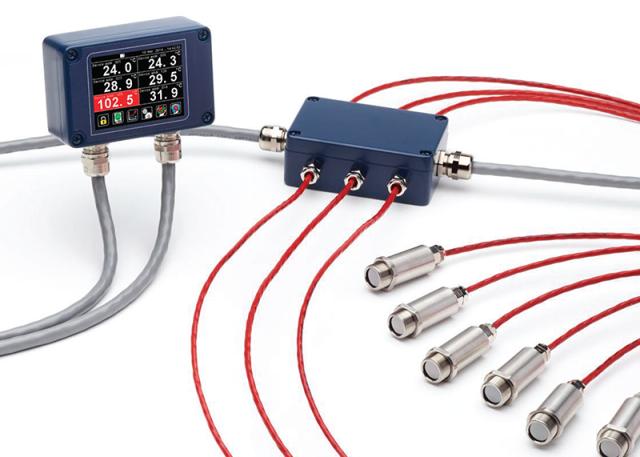
- Built for the area: 316 stainless steel sensor bodies shield the sensors from electrical interference and keep them clear of the dust, ash and flame that wear out standard sensors here.
- Local display: optional PM180 6-channel touchscreens near the sensors help maintenance engineers find the hot reading quickly, and log data to a microSD card.
- Connectivity: RS485 Modbus RTU to your Modbus master, and Modbus TCP from optional panel PCs to SCADA.
- Scalability: each PM180 display handles up to 6 sensors, and panel PCs can bring several PM180 networks together for multiple tyres.
This system adds to the main shell scanner rather than replacing it: see kiln shell hot spot monitoring for the full-shell view, and protects the tyre area from overheating and ovality problems that a shell-only view would miss.
FAQ
Common questions
Why can't a normal kiln shell scanner see under the tyre?
A shell scanner's sensors are aimed at the shell from the side, along the kiln's length, so the tyre (riding ring) physically blocks the view of the shell directly underneath it. That's a problem because the tyre area carries the kiln's load and is one of the most critical places for shell deformation.
How does under-tyre monitoring detect refractory damage?
Infrared sensors are aimed into the gap under the tyre and read the shell's temperature continuously as the kiln rotates. When refractory has thinned or fallen away in that hidden zone, the shell above it heats up, and the system alarms. Multiple sensors also reveal uneven heating across the tyre width.
Does under-tyre monitoring replace the main kiln shell scanner?
No, it adds to it rather than replacing it. The main shell scanner covers the visible shell along the kiln's length, while the under-tyre system covers only the zone the tyre hides. Running both together gives full coverage, including the load-critical tyre area.
Can under-tyre kiln monitoring cover more than one tyre?
Yes. Each PM180 display handles up to 6 sensors, and panel PCs can bring several PM180 networks together, so a kiln with multiple tyres can be covered from one system. Tell us how many tyres and we'll size the sensor count and displays.
Need help?
Can't find what you need?
Our team helps you select the right kiln hot spot monitoring sys. under tier products for your application. Request a quote or discuss your requirements.
Expert product guidance
Tailored selection of kiln hot spot monitoring sys. under tier instruments
Custom solutions
Instruments customized for your specific industrial setup
Trusted global brands
Full warranty and official documentation support