Category
Kiln Shell Scanner & Hot Spot Monitoring
Find refractory damage early by monitoring the kiln shell for hot spots.
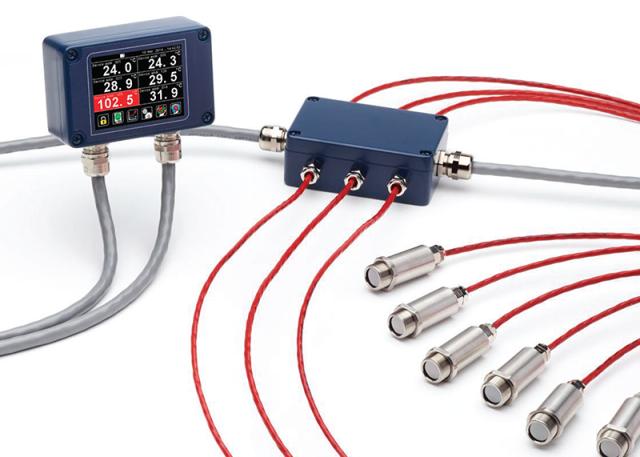
A kiln shell scanner tracks the steel shell's temperature as a rotary kiln turns, so a thinning or cracked refractory lining shows up as a hot spot before it deforms the shell. The Calex system uses PyroMiniBus sensors and PM180 displays for cement, lime and mineral kilns. For the tyre's blind spot, see under-tyre monitoring.
1 Product · Kiln Shell Hot Spot Monitoring System
Selection guide
Kiln Shell Scanner & Hot Spot Monitoring Guide
How a kiln shell scanner works
PyroMiniBus infrared sensors along the kiln measure many points on the rotating shell at once, without contact, up to 1000 °C. Kiln shells normally run at 400 to 500 °C, too hot for a contact sensor to survive. The system builds a temperature picture of the shell as it turns, highlights hot spots where the refractory has thinned or fallen away, and raises an alarm so operators can adjust the flame, add cooling, or plan a repair at the next stop.
The Calex system
- Sensor construction: 316 stainless steel bodies, with air-purged windows or shields to keep the optics clear of kiln dust and smoke.
- Local display: optional PM180 6-channel touchscreens near the sensors show which point is hot and log data to a microSD card.
- Connectivity: sensors talk RS485 Modbus RTU directly to your Modbus master, with an optional panel PC sharing every sensor's data over Ethernet (Modbus TCP) with SCADA.
- Sizing: tell us your kiln length, diameter and control system and we'll propose the sensor count and layout.
Benefits include early warning of refractory damage, fewer unplanned kiln stops, and a history of shell temperatures to plan relining. The tyre area is a blind spot for this scanner: see kiln hot spot monitoring under the tyre for that zone.
FAQ
Common questions
What is a kiln shell scanner and why is it needed?
A kiln shell scanner is an infrared monitoring system that reads the steel shell's temperature continuously as the kiln rotates. The refractory lining inside protects the shell from process heat, so when it thins, cracks or falls away, that spot heats up. Catching it early avoids a deformed shell and an unplanned stop.
What temperature does a kiln shell normally run at?
A healthy kiln shell typically runs at 400 to 500 °C, too hot for a contact sensor to survive continuously. The Calex system's PyroMiniBus infrared sensors read up to 1000 °C without touching the shell, so they keep monitoring through both normal operation and a developing hot spot.
How does the sensor survive the dust and heat around a kiln?
The sensor bodies are 316 stainless steel, and air-purged windows or shields keep the optics clear of the dust and smoke that build up around a rotary kiln. This construction is what lets the sensors run continuously in the kiln area rather than needing frequent cleaning or replacement.
Can kiln shell monitoring data reach our control room?
Yes. The sensors talk RS485 Modbus RTU to your Modbus master directly, and an optional panel PC can bring every sensor on the kiln together and share the data over Ethernet with Modbus TCP to SCADA. Optional PM180 touchscreens also give a local reading right at the kiln.
What information do you need to quote a kiln shell monitoring system?
Tell us your kiln's length and diameter, and what control system it should report to, whether that's a Modbus master, a panel PC or SCADA over Modbus TCP. We'll propose the PyroMiniBus sensor count and layout, along with the PM180 display option if you want a local readout.
Need help?
Can't find what you need?
Our team helps you select the right kiln shell hot spot monitoring system products for your application. Request a quote or discuss your requirements.
Expert product guidance
Tailored selection of kiln shell hot spot monitoring system instruments
Custom solutions
Instruments customized for your specific industrial setup
Trusted global brands
Full warranty and official documentation support