Category
Thermal Flow Meters for Laminar Air
Measure low air and gas velocities with the Höntzsch TA10C thermal probe.
A thermal flow meter reads velocity from how a gas stream cools a heated element, which makes it sensitive at low, laminar flows a vane wheel probe can't pick up. The Höntzsch TA10C suits clean rooms and pharma, with 4 to 20 mA or 0 to 10 V output, and an ATEX version for Zone 2 and 22.
1 Product · Thermal Flow Meter
Selection guide
Thermal Flow Meters for Laminar Air Guide
How a thermal flow meter works
The TA10C heats a small element and measures how quickly the passing gas carries heat away. Faster flow cools the element faster, and that relationship converts into a velocity reading. Because the effect is measurable even at very low speeds, it suits laminar flow that a mechanical vane wheel probe would struggle to spin reliably, but it isn't intended for high-velocity or turbulent conditions where the cooling relationship becomes less predictable.
How to choose a thermal flow meter
- Flow type: use it for low, laminar flows only. For higher or turbulent velocities, a vane wheel or vortex probe suits better.
- Output: choose the 4 to 20 mA or 0 to 10 V version to match your BMS or PLC input.
- Hazardous area: an ATEX version is available for Category 3G and 3D, covering Zone 2 and 22, but not the higher-risk Category 1 or 2 zones.
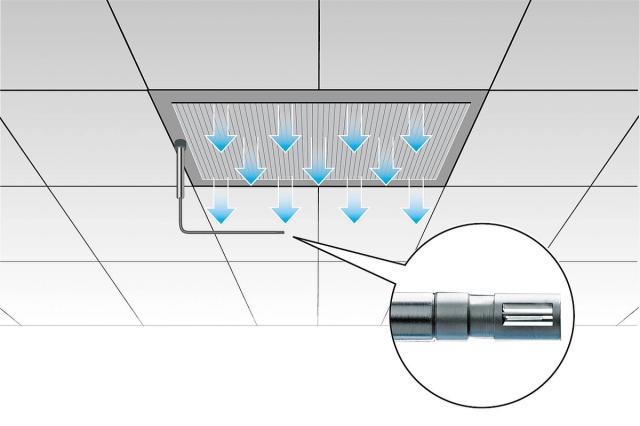
- Environment: it's designed for stationary monitoring in clean rooms, laminar flow benches, gloveboxes, isolators and pharma or semiconductor process air, where a stable, sensitive low-flow reading matters more than a wide range.
For a hazardous-area version built for higher-risk zones, see flameproof airflow and velocity transmitters. For higher-velocity air and gas flows, see vane wheel flow meters.
FAQ
Common questions
What is a thermal flow meter used for?
It measures very low, laminar air or gas velocity from the cooling effect on a heated sensing element, which makes it sensitive where a mechanical probe would give an unreliable reading. Typical uses are laminar flow benches, clean room ceilings, gloveboxes, isolators, and semiconductor or pharma process air.
What is thermal flow meter working principle?
A small element is heated above the gas temperature, and the passing gas carries heat away at a rate that depends on its velocity. The device measures that cooling rate and converts it into a flow signal. It's the same basic principle used in hot-wire anemometry, applied here to stationary, low-velocity monitoring.
Can a thermal flow meter be used in a hazardous area?
The Höntzsch TA10C has an ATEX version for Category 3G and 3D, covering Zone 2 and 22. It isn't rated for the higher-risk Category 1 or 2 zones, so for those you'd need a different, higher-category product such as a vane wheel probe's Ex-d version.
Is a thermal flow meter suitable for high-velocity ducts?
No, it's designed for low, laminar flows such as clean room ceilings or laminar flow benches, not high-velocity or turbulent air. For higher velocities and a wider range, a vane wheel probe reading up to 120 m/s or a vortex probe with a 1:80 turndown is the better fit.
Need help?
Can't find what you need?
Our team helps you select the right thermal flow meter products for your application. Request a quote or discuss your requirements.
Expert product guidance
Tailored selection of thermal flow meter instruments
Custom solutions
Instruments customized for your specific industrial setup
Trusted global brands
Full warranty and official documentation support