Category
Averaging Flow Sensors for Ducts
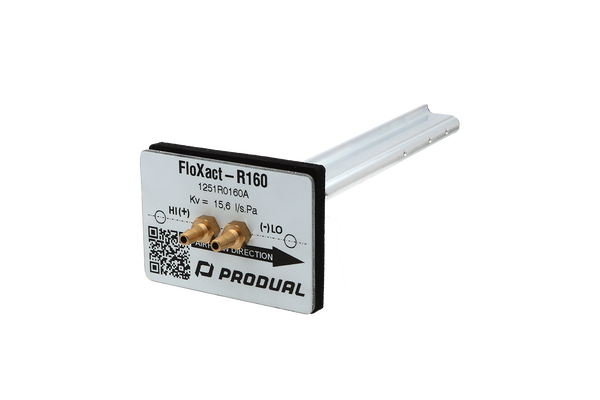
Measure air volume in ducts accurately with the Produal FloXact averaging probe.
An averaging flow sensor samples total and static pressure at several points across a duct, giving a truer reading than a single-point probe where the air isn't evenly distributed. The Produal FloXact amplifies its signal 2.5 times for accurate readings down to 1.0 m/s, and pairs with a differential pressure or flow transmitter such as the Produal DPT-Flow.
1 Product · Averaging Flow Sensor
Selection guide
Averaging Flow Sensors for Ducts Guide
What an averaging flow sensor is used for
Air speed across a duct is rarely uniform: it's faster in the centre and slower near the walls, and bends or dampers upstream make it worse. A single-point pitot tube can miss this and read too high or too low. The FloXact instead senses total and static pressure at multiple points across the duct and combines them into one averaged differential pressure signal, which a separate transmitter converts into a flow or velocity reading.
How to choose an averaging flow sensor
- Low-flow sensitivity: the FloXact's signal is amplified 2.5 times, so it stays usable down to 1.0 m/s (200 fpm), well below what an unamplified probe can resolve reliably.
- Pairing: it isn't a standalone gauge. Pair it with a differential pressure or flow transmitter, such as the Produal DPT-Flow, to get an actual flow reading or output signal.
- Duct fit: it's sized to the duct cross-section, so measure your duct dimensions before ordering, in the same way as any averaging probe.
- Installation cost: it's a simpler, more cost-effective installation than a full averaging grid where budget or duct access is limited, at some trade-off in accuracy on very large ducts.
For HVAC air balancing specifically, see HVAC airflow probes. For maximum accuracy in large ducts, see the Wilson flow grid.
FAQ
Common questions
What is an averaging flow sensor?
It's a probe that senses air pressure at several points across a duct's cross-section, rather than one, and combines them into a single averaged reading. This gives a more representative flow figure than a single-point pitot tube, especially where airflow is uneven due to bends, dampers or fittings upstream.
Does the FloXact give a flow reading by itself?
No, it needs a separate differential pressure or flow transmitter, such as the Produal DPT-Flow, to convert its pressure signal into a flow or velocity value. The FloXact is the sensing element in the duct; the transmitter does the calculation and provides the output signal.
How low a flow can an averaging flow sensor measure?
The Produal FloXact reads down to about 1.0 m/s (200 fpm), because its signal is amplified 2.5 times compared with an unamplified averaging probe. Below that, the pressure difference becomes too small to resolve reliably, so a thermal flow meter suits lower flows better.
How is an averaging flow sensor different from a single pitot tube?
A single pitot tube samples one point in the duct, which can be biased by uneven flow profiles from nearby bends or dampers. An averaging sensor samples multiple points across the same cross-section and blends them, giving a reading closer to the true duct average without repositioning a probe by hand.
Where is an averaging flow sensor typically installed?
It's fitted in supply, extract or process air ducts where accurate volume flow matters, such as air handling units, energy monitoring points and balancing stations. It suits ducts with limited straight run, where a single-point reading would be unreliable.
Need help?
Can't find what you need?
Our team helps you select the right averaging flow sensor products for your application. Request a quote or discuss your requirements.
Expert product guidance
Tailored selection of averaging flow sensor instruments
Custom solutions
Instruments customized for your specific industrial setup
Trusted global brands
Full warranty and official documentation support