Category
Busbar Temperature Monitoring
Spot overheating busbar joints in switchgear and panels before they fail, with Calex non-contact monitoring.
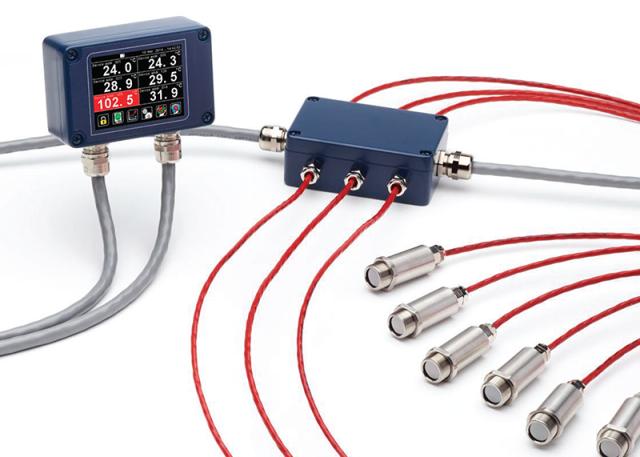
Busbar temperature monitoring uses non-contact infrared sensors, aimed at the busbar joints inside a switchgear cabinet, to catch a deteriorating connection before it fails. As a connection degrades, its resistance rises, it gets hotter, and that heat causes more damage, with a fire risk. Calex sensors and a PM180 hub read and log the joints, staying isolated from the voltage.
1 Product · Busbar Temperature Monitoring
Selection guide
Busbar Temperature Monitoring Guide
How busbar temperature monitoring works
Non-contact infrared sensors are mounted inside the cabinet, aimed at the busbar joints. They read the surface temperature instantly and continuously while staying physically isolated from the voltage, so there's no need to open a live cabinet to check a joint by hand. Typically 6 sensors cover a cabinet: 3 on the incoming busbars and 3 on the outgoing ones.
Why monitor busbar joints
- Early warning: spot a deteriorating joint weeks before it fails, instead of finding out during a breakdown.
- Planned maintenance: schedule a repair or re-torque at the next outage rather than reacting to a trip.
- Safety: the infrared sensors measure without contact, so surveys no longer mean opening live cabinets.
- Display and logging: a PM180 hub displays and logs the readings and raises alarms, communicating over RS485 Modbus RTU.
- Site-wide visibility: panel PCs can bring several cabinets together over Ethernet with Modbus TCP, for one view of every monitored joint.
The infrared sensors themselves are described on infrared temperature sensors / pyrometers, and the same PM180 hub is used on our kiln shell hot spot monitoring systems.
FAQ
Common questions
Why does a busbar joint need temperature monitoring?
As a busbar connection degrades, its resistance rises, which makes it run hotter, and that extra heat causes further damage, with a risk of fire or explosion. Continuous infrared monitoring catches this rise weeks before the joint fails, so maintenance can be planned instead of reacting to a breakdown or an unplanned trip.
How many sensors does a busbar monitoring system need per cabinet?
Typically 6 sensors per cabinet: 3 on the incoming busbars and 3 on the outgoing ones, each aimed at a joint. The sensors read continuously and pass the values to a PM180 hub, which displays, logs and alarms on all 6 channels. Tell us your cabinet layout and we'll confirm the sensor count.
Is it safe to monitor busbar temperature without opening the cabinet?
Yes, that's the point of an infrared system. The sensors read the joint's surface temperature from a distance and stay physically isolated from the voltage, so engineers no longer need to open a live cabinet for a manual thermal survey. Readings continue automatically, day and night.
Can busbar monitoring data reach a SCADA system?
Yes. The PM180 hub communicates over RS485 Modbus RTU. Where several cabinets need monitoring together, a panel PC can bring multiple PM180 units onto one Ethernet network using Modbus TCP, giving a single view of every joint across a switchroom.
Need help?
Can't find what you need?
Our team helps you select the right busbar temperature monitoring products for your application. Request a quote or discuss your requirements.
Expert product guidance
Tailored selection of busbar temperature monitoring instruments
Custom solutions
Instruments customized for your specific industrial setup
Trusted global brands
Full warranty and official documentation support