Category
Air Velocity Transmitters for HVAC
Monitor air velocity in HVAC ducts and air handling units and send it to your BMS with Produal transmitters.
An air velocity transmitter for AHUs confirms that an air handling unit, fan or duct is delivering the airflow it was designed for, feeding a continuous reading to the BMS rather than a simple pass or fail signal. Produal's AVT and DPT-Flow prove fans, alarm on low airflow and balance supply and extract air across a building.
2 Products · Air Velocity Transmitters
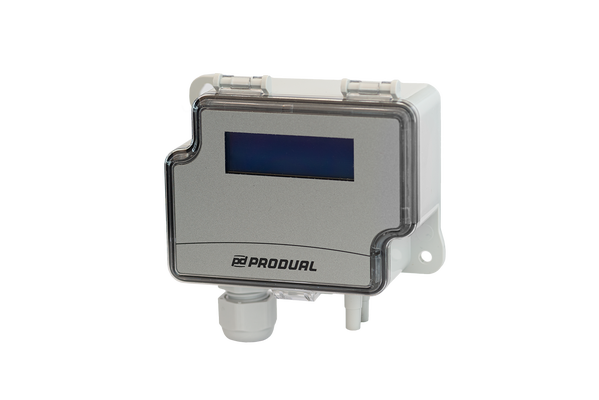
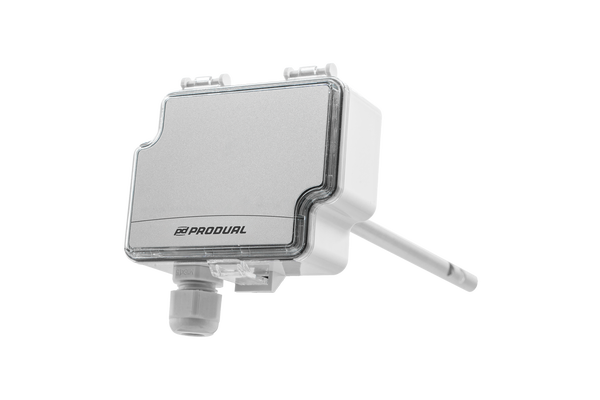
Selection guide
Air Velocity Transmitters for HVAC Guide
How air velocity transmitters work in HVAC
The Produal AVT measures air velocity and temperature directly in the duct, with a field-selectable range and output and an optional relay output for alarms. The Produal DPT-Flow instead measures flow rate on a centrifugal fan or, with the FloXact probe, in a duct, calculating it from differential pressure rather than sensing velocity directly. Both send a continuous signal, so the BMS can trend the reading rather than only reacting to a single alarm point.
Typical HVAC uses
- Fan proving and low-airflow alarms: confirming a fan is actually running before dependent equipment starts.
- Monitoring supply and extract airflow in AHUs: tracking both sides of the air balance continuously.
- Clean room and laboratory airflow monitoring: where airflow affects pressure cascades and containment.
- Spotting falling airflow as filters clog: an early warning before a filter alarm trips, giving time to plan maintenance.
Velocity or volume flow?
- Velocity: the AVT is fine for fan proving and alarms.
- Volume flow: for balancing or energy calculations you need volume flow, which comes from the DPT-Flow, since velocity alone doesn't account for the duct's cross-sectional area.
- Beyond HVAC: for process air and general industrial use, see Air Flow and Velocity Transmitters.
FAQ
Common questions
Can one device prove the fan and send airflow to the BMS?
Yes. The Produal AVT sends its air velocity reading continuously to the BMS and has an optional relay output that trips a low-airflow alarm, so one transmitter covers both fan proving and ongoing monitoring rather than needing two separate devices.
Where should an air velocity transmitter be mounted in a duct?
On a straight section of duct, away from bends, dampers and fans, so the airflow profile is even across the sensor. Mounting too close to a fitting gives an uneven flow that can skew the reading and cause false alarms.
Velocity or volume flow for my BMS?
Velocity from the AVT is fine for fan proving and low-airflow alarms, where you just need to confirm air is moving. For balancing zones or energy calculations, use volume flow instead, which the DPT-Flow provides.
What does the DPT-Flow measure that the AVT doesn't?
The DPT-Flow calculates flow rate from differential pressure at a fan's measuring points or, with the FloXact probe, across a duct, giving volume flow rather than just velocity. This suits balancing and energy monitoring where an actual air volume figure is needed.
Can an air velocity transmitter alarm before a filter fully clogs?
Yes. As a filter loads with dust, airflow past it falls gradually before it reaches a hard block. Trending the AVT's continuous reading lets the BMS flag that fall early, so maintenance can be planned before the filter alarm trips and airflow drops sharply.
Need help?
Can't find what you need?
Our team helps you select the right air velocity transmitters products for your application. Request a quote or discuss your requirements.
Expert product guidance
Tailored selection of air velocity transmitters instruments
Custom solutions
Instruments customized for your specific industrial setup
Trusted global brands
Full warranty and official documentation support