Category
Pendulum Level Switches for Bulk Solids
Simple, robust high-level and flow detection for bulk solids on conveyors and in silos.
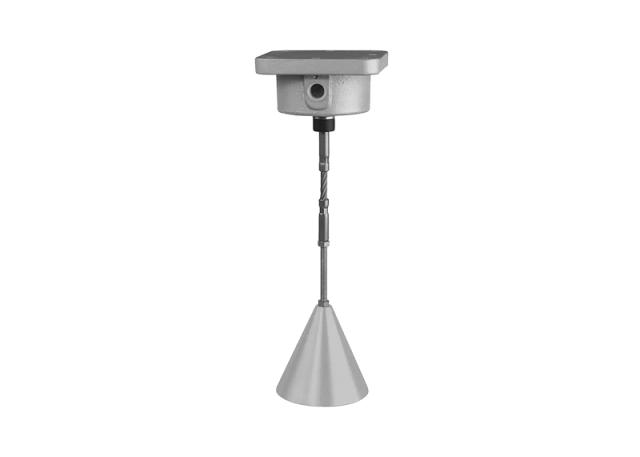
A pendulum level switch hangs inside a silo and trips when bulk material pushes it out of vertical, giving a simple full or empty indication with nothing to calibrate. Filsa's MS-1 handles bulk densities of 0.3 to 3 t/m3 and grain sizes up to 100 mm, in a standard version and an ATEX version for dust and gas.
2 Products · Pendulum Level Switch

Selection guide
Pendulum Level Switches for Bulk Solids Guide
How a pendulum level switch works
The pendulum hangs vertically from the switch body inside the vessel, and as material rises and reaches it, the material pushes the pendulum sideways, actuating an internal switch. When the level falls again, the pendulum swings back to vertical and the contact resets. With no membrane or probe to fill or foul, it gives a dependable single high or low trip point in coarse or bridging bulk solids.
How to choose a pendulum level switch
- Material: rated for bulk densities of 0.3 to 3 t/m3 and dusty, powdery, granulated and grainy goods, with grain sizes up to 100 mm.
- Protection and pressure: IP66, maximum vessel pressure +0.5 bar.
- Temperature: maximum product temperature 80 °C.
- Contact: the standard version switches up to 250 VAC at 15 A; the ATEX version uses an intrinsically safe contact, Uo < 30 V DC and Ii < 100 mA, for connection through a barrier.
- Hazardous areas: for combustible dust or gas, choose the ATEX pendulum level switch, certified II 1/2D Ex ta/tb IIIC T80 °C Da/Db for dust and 2G Ex ib IIB T6 Gb for gas.
For a membrane-type switch on abrasive solids instead, see boot and membrane level switches. For other point-level technologies, see point level switches.
FAQ
Common questions
How does a pendulum level switch work?
A pendulum hangs vertically inside the vessel from the switch body. When bulk material reaches it, the material pushes the pendulum out of vertical, and that tilt actuates the switch contact. It resets automatically once the level falls and the pendulum swings back.
What grain size can a pendulum level switch handle?
Up to 100 mm, and bulk densities from 0.3 to 3 t/m3. That covers most powders, granules and coarse bulk solids in silos, bunkers and hoppers, without the probe or membrane being damaged by lumps.
Where is a pendulum level switch used?
Filsa's datasheet describes the MS-1 as a full and empty limit switch for silos, bins and vessels holding bulk solids. Hung from the top, it tilts when material reaches it and returns to vertical as the level falls. If you're looking at another use, such as a transfer point, tell us the installation and we'll check it with the maker.
Is an ATEX version of the pendulum level switch available?
Yes. The MS-1 ATEX is certified II 1/2D Ex ta/tb IIIC T80 °C Da/Db for combustible dust and 2G Ex ib IIB T6 Gb for gas atmospheres, with an intrinsically safe contact rated Uo below 30 V DC and Ii below 100 mA. Confirm your zone and we'll match the version.
What is the difference between a pendulum switch and a membrane level switch?
A pendulum switch detects material by mechanical tilt, with the sensing element inside the vessel; a membrane switch detects it by pressure through a membrane in the vessel wall, with nothing protruding inside. Both give a single switch point, but a membrane switch suits abrasive solids that could wear a pendulum arm faster.
Need help?
Can't find what you need?
Our team helps you select the right pendulum level switch products for your application. Request a quote or discuss your requirements.
Expert product guidance
Tailored selection of pendulum level switch instruments
Custom solutions
Instruments customized for your specific industrial setup
Trusted global brands
Full warranty and official documentation support