Category
Ultrasonic Level Transmitter
Non-contact level measurement for water tanks, sumps and open channels.
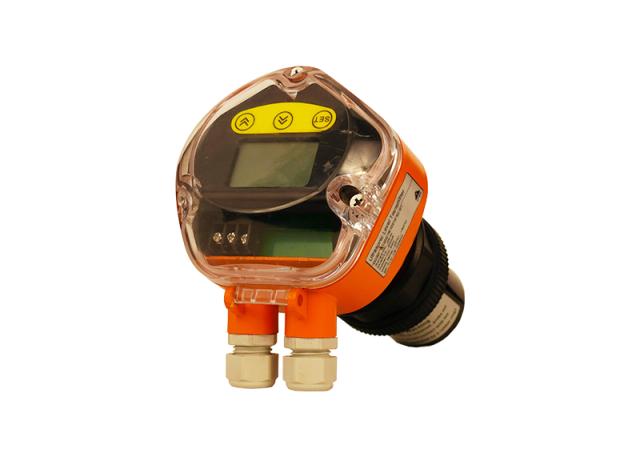
An ultrasonic level transmitter mounts above the liquid and measures the time a sound pulse takes to travel to the surface and back, giving a continuous reading with nothing touching the water. The Trumen TLUC suits water tanks, sumps and open channels, with 4 to 20 mA, RS232, RS485 Modbus, relay and alarm outputs, on threaded or flange mounting.
1 Product · Ultrasonic Level Transmitter
Selection guide
Ultrasonic Level Transmitter Guide
How an ultrasonic level transmitter works
A transducer in the sensor head sends a short ultrasonic pulse straight down at the liquid surface, then measures the time until the echo returns. Because sound travels at a known speed through air, that time converts directly into distance, and the transmitter subtracts it from the mounting height to give the liquid level. Nothing touches the liquid, so there's no fouling or corrosion of the sensing element.
How to choose an ultrasonic level transmitter
- Mounting: threaded connections (M48, M60, M78 or G2) suit most tank openings, and a flange mount suits larger nozzles or where the sensor needs a fixed, level seating.
- Wiring: a 2-wire 4 to 20 mA loop keeps installation simple; the 4-wire version adds separate power for longer runs or extra outputs.
- Communication: RS232 or RS485 Modbus lets the BMS poll the level directly, alongside the relay and alarm outputs for local pump control or alarms.
- Application: beyond tank level, the TLUC also measures volume and open channel flow over weirs and flumes, so one sensor can cover a flow monitoring point as well as a tank.
- Surface condition: foam, heavy turbulence or steam above the liquid can affect the echo; for tanks with these conditions, a hydrostatic transmitter is usually more reliable.
For submerged measurement where non-contact isn't required, see the hydrostatic continuous level transmitter.
FAQ
Common questions
Does the ultrasonic sensor touch the water?
No. It mounts above the liquid and measures the time an ultrasonic pulse takes to travel down to the surface and back, so nothing in the sensor is wetted. That avoids the fouling and corrosion that a submerged probe can suffer in dirty or aggressive water.
Can an ultrasonic transmitter measure open channel flow?
Yes. The Trumen TLUC can monitor open channel flow over weirs and flumes as well as tank level, because both applications use the same non-contact distance measurement, just referenced to a flow calculation instead of a tank profile.
Which outputs does the ultrasonic level transmitter offer?
The TLUC gives a 4 to 20 mA output in 2-wire or 4-wire form, plus RS232 and RS485 Modbus communication, and relay and alarm outputs. That covers a simple analogue BMS input, a Modbus-polled network, or local relay control of a pump or valve.
What mounting does the ultrasonic sensor need?
It mounts on top of the tank on a threaded connection (M48, M60, M78 or G2) or a flange, positioned so the sound pulse has a clear path straight down to the liquid without hitting internal fittings, ladders or fill pipes.
Ultrasonic or capacitance level transmitter, which suits my tank?
Ultrasonic suits tanks where nothing should touch the liquid, such as treated water or where you want to avoid fouling. Capacitance suits tanks where a probe can be fitted and where the liquid may be diesel or oil as well as water. Tell us the liquid and mounting and we'll confirm.
Need help?
Can't find what you need?
Our team helps you select the right ultrasonic level transmitter products for your application. Request a quote or discuss your requirements.
Expert product guidance
Tailored selection of ultrasonic level transmitter instruments
Custom solutions
Instruments customized for your specific industrial setup
Trusted global brands
Full warranty and official documentation support